

Buzz-Off Zebra Stripe Technology
The evolution of the zebra’s striped coat has been a hot topic amongst experts for over 150 years with many in depth studies carried out by scientists as to why Zebras have stripes and their connection with flies.
One of the earliest studies to Bucas’ knowledge is that of scientists painting wooden pallets containing vegetable oil, in different patterns. There was one painted with black and white stripes to mimic a zebra, one was all black and the other all white.
The scientists then placed the pallets in a fly-infested field and results showed that there were far more flies in the black painted pallets, fewer in the white painted pallets but the fewest flies of all were found in the pallets painted with thin black and white stripes.
In more recent news, research professionals from the University of Bristol and UC Davis, California, have added further evidence to theories that the primary purpose of zebras' stripes is to avoid blood-sucking parasites.
An article published in 2019 by University of Bristol on Phys.org highlights a study carried out by Professor Tim Caro, Dr. Martin How and colleagues at a livery in North Somerset. They have been using video analysis techniques to investigate the behaviours of tabanid horse flies around captive zebras and domestic horses.
This study shows that stripes don't deter horse flies from a distance, with both zebras and domestic horses experiencing the same rate of circling from the flies. However, video analysis revealed differences in approach speed, with horse flies failing to slow down on approach to zebras, which is essential for a successful landing.
Their study showed that horse flies just seem to fly over zebra stripes or bump into them. Therefore, they found far fewer successful landings took place on zebras compared to horses. The reduced ability to land on the zebras’ striped coat is believed to be happening because of the disruption the stripes cause to a fly’s visual system when approaching at close proximity.
The study has led them to believe that stripes may dazzle flies in some way once they are close enough to see them with their low-resolution eyes.
There has also been a study carried out on painting zebra stripe patterns on cows which has been found to reduce fly bites by 50%. The study, published by Japanese scientists in the journal Plos One, found fly attacks were “significantly reduced” by the disguise. The scientists believe the striped pattern confuses the fly’s motion detection and deters the pests.
Buzz-Off Zebra
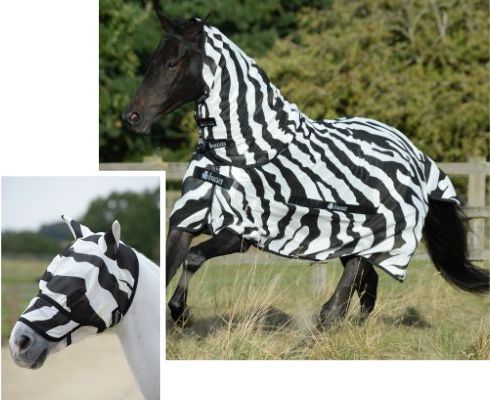
Based on lots of in-depth research, Bucas developed and launched their iconic Buzz-Off Zebra fly rug in 2012, a first of its kind, revolutionary design fly rug with thin zebra-like stripes, to confuse and repel flies to keep horses free from the stresses of summer flies.
The Bucas Buzz-Off Zebra range of fly and insect protection products are made from a specially developed lightweight fine mesh fabric that blocks even the smallest of insects.
Providing body and neck protection for horses or ponies, the Buzz-Off Zebra Full Neck Rug helps to protect the mane from flies and an elasticated brow band helps keep the neck piece in place as the horse grazes.
The Buzz-Off Rain Zebra Rug combines the Zebra Full Neck Fly Sheet with a waterproof upper to protect the horse. The integrated neck and waterproof upper offers full body and neck protection from flies as well as letting the rain roll off the horse’s back.
Features of the Buzz-Off rugs include a T-bar with Snap-lock front closure, silk-feel lining on the shoulders, an elasticated Bucas belly pad which helps to protect the belly and stabilise the rug, leg straps and a tail flap for additional protection.
The Buzz-Off Zebra Fly Mask provides excellent protection and can be used with the Buzz-Off Range or on its own.
If you’d like to know more contact Zebra Products.
T +44 (0)1352 763350
E: info@zebraproducts.co.uk
W: www.zebraproducts.co.uk
Facebook: @Zebraproducts
Instagram: @Zebraproducts