
How it’s made
Behind every bag of Emerald Green Feeds lies a production process built on precision timing, specialist machinery and knowledge that takes generations to develop. In the second part of our series, Equestrian Business goes inside the operation.
Pick up a bag of Emerald Green Feeds and you are holding the end result of a process that began, depending on the time of year, somewhere between a few months and a few weeks earlier in a Lincolnshire field. The growing season on the farm starts around mid to late April, and from that point a combination of expertise, machinery and carefully applied judgement carries the crop from soil to shelf.
In the field
The farm grows both grass and alfalfa, each cut three to four times a year. Grass fields stay in production for around five growing seasons before being rotated into a different crop; alfalfa fields for around three. Rotation matters. “It does mostly improve the quality of the subsequent crops,” says company representative Peter Burchnall, and the farm’s rotation schedule is planned accordingly.
Deciding when to cut is one of those skills that looks straightforward from the outside but is anything but. The team is not measuring height; they are assessing volume. There needs to be enough crop present for the forage harvester to collect effectively. “Fescue grass doesn’t grow particularly tall before going to seed,” Peter explains, which makes height a poor guide. What matters is whether there is sufficient material for the machinery to do its job.
The margin for error is narrow. “The window between perfect to cut and past its best can be around seven days,” says Louise Burchnall, and the weather determines where in that window you are working on any given morning. A crop that misses its moment does not go to waste — Emerald Green Feeds has other customers for dried forage, and anything that falls short of the standard required for the equine range is redirected accordingly. Getting the timing right is what the whole operation is geared around.
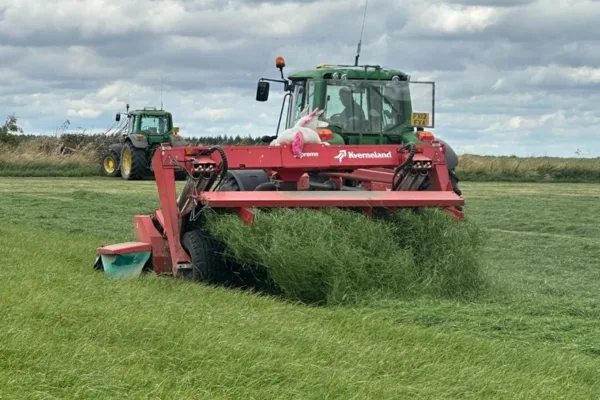
Harvest involves a coordinated sequence of machinery: a mower to cut, a tedder to fluff and turn the material in the field to help it dry, a rake to draw it into a swath and the forage harvester itself, which gathers, chops and blows the crop via a spout into a trailing vehicle. Metal detection is built into the harvester. What might surprise people, though, is how much of the process still comes down to the people running it. Around 80% depends on human skill, experience and judgement to co-ordinate effectively. Only 20% is automated.



The drying process
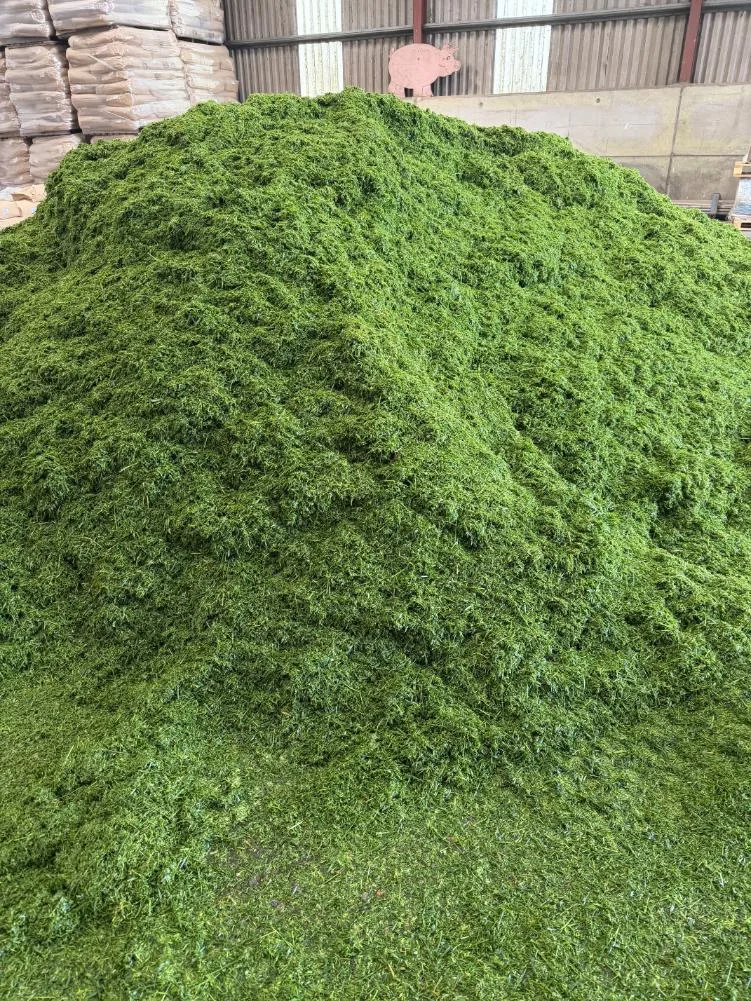
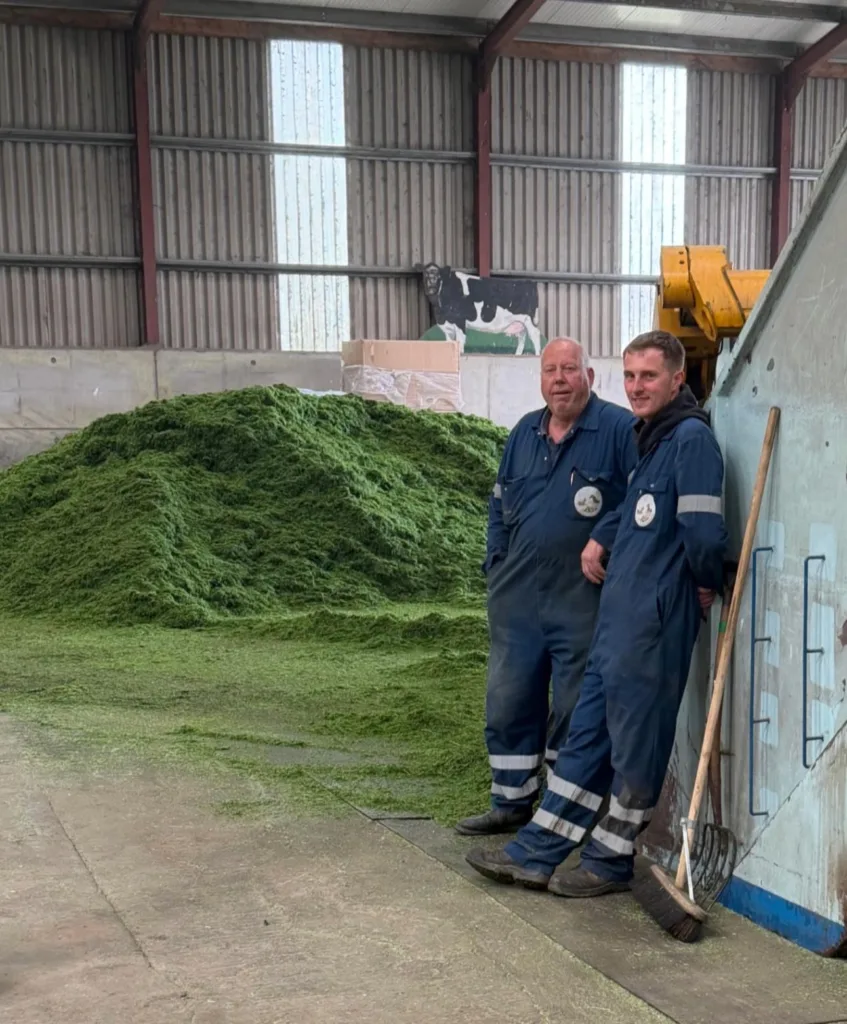
Once the crop is cut, the clock starts. In warm, dry conditions the forage needs to reach the dryer within 12 hours; in cooler or more humid weather that window extends to 24 or 36 hours. At the height of summer it can be considerably less. “It’s perfectly normal for the forage to reach the dryer within less than an hour of being mown,” Louise says, “particularly during the height of summer when it’s most abundant.” Nutrient content can begin to decline from the moment a crop is cut, but the timing windows applied are carefully calculated to keep any loss to a minimum.
The dryer at the heart of the operation has been there since 1966. “It’s essentially a huge tumble dryer,” Peter says, which is as good a description as any: hot air blown into one end of a slowly revolving drum, moisture extracted from the other in what he calls a single-pass operation. The plant has been updated and modernised many times over, but the principle is unchanged.
Temperature is set manually rather than by formula. The furnace heats to approximately 800 degrees C, and the setting is determined each time by testing the moisture content of the fresh crop before processing begins. Control measures guard against over-drying, but the process is a tailored one, adjusted to what has come out of the field that day.
Quality checking combines visual inspection, moisture sampling and laboratory testing. Beta-carotene is among the key nutrients the drying process is specifically designed to preserve, and sampling across the 3,000 to 3,500 tonnes produced each year shows sufficient levels are consistently retained.
There is one quality signal that tends to catch visitors off guard. “The dried forage smells amazing,” Louise says. “We regularly get compliments on the smell.” Correctly dried alfalfa and grass have a strong, characteristic aroma, and it is, in its way, one of the more immediate signs that a batch has come off well.
From dryer to bag
When the dried forage exits the drum it passes through a stone trap that removes foreign objects, with magnets positioned at multiple points throughout the facility for further metal detection. From here, the forage moves in one of two directions depending on the final product.
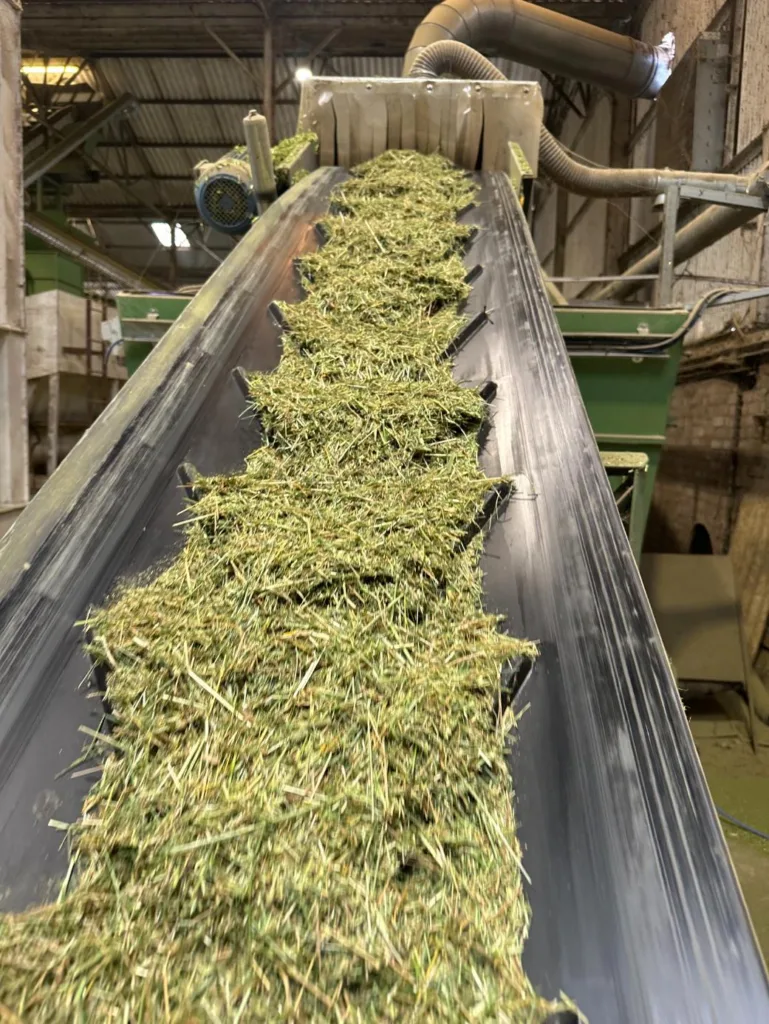
To make pellets, the dried forage is milled to a flour-like consistency and then pressed through a die using pressure alone. No binding agents are involved. Emerald Green Feeds uses a 6mm die, and while the pressure applied is always consistent, the density of the finished pellet can vary slightly depending on the growth stage and growing conditions of the crop. “The density isn’t so varied as to significantly affect the way a horse chews it,” Peter says. Pellets cool by passing downward through a tower with air blown through at different levels. For chop, the forage moves along a slow-moving conveyor through a large cooling chamber after drying.
Sign-off at every stage is a collective process, and it begins before the crop even reaches the dryer. Crop assessment starts in the field, ahead of harvest, and quality checks continue through every step of production. Accreditation under FEMAS and BETA NOPS standards demands constant monitoring for contaminants including foreign objects, ragwort and poppies. The packaging is recyclable and moisture-repellent, built to handle distribution and protect the product in storage. It is what allows the range to achieve a two-year shelf life, and what means every batch that leaves the facility can be traced back to the field it came from.
Quality and the unexpected
What would surprise people most about the process? “Probably the time involved, the long working hours, the constant battle with the weather and the level of expertise and experience required,” says Louise. Five generations in, that has not changed. “We’re always learning,” she adds.
One of the more unexpected challenges of recent years is one that would never cross the mind of someone picking a bag off a shelf: litter dropped by passing motorists. Fields that border roads are now farmed with wider margins at the edges, and regular litter-picks are carried out to minimise contamination risk. It is a small thing, but it captures something essential about how the operation runs. From the edge of the field to the inside of the bag, it is human attention at every stage that holds the process together.