

Weight management is so often associated with overweight or over conditioned animals, but it is an unfortunate stigma, as weight control is also important in those who are at their ideal, in order to keep them at their best!
Horses are athletes too
Horses in full work are very much elite athletes and much like their human equivalents such as Jessica Ennis-Hill or Roger Federer, they benefit from a team-based approach from their support professionals (i.e. riders, vets, farriers, nutritionists), and data that is collected through comprehensive monitoring systems. Dr Courtney Miller BS BVetMed MRCVS, Head of Nutrition and Technical at Dodson & Horrell Ltd rationalises that without understanding a horse’s ‘normal’, it can be difficult to pick up on the marginal gains that occur day to day when working towards a goal. However, monitoring isn’t just for the tip top horses in sport either. Collecting data can benefit the individual no matter the circumstance. If a horse is retired, under conditioned, over conditioned, starting a new discipline, recovering from an injury or illness; he or she will benefit from an establishment of their baselines and subsequent comparison of respective parameters to them.
 What is normal?
So, what information should we collect? Specific to weight management, if horse owners have access to a weighbridge, taking regular weights at consistent points in their horse’s routine will help establish what is normal. This information can be stored alongside body condition scores, photos, heart and belly girths, taken at set intervals in a management programme, to give a more comprehensive picture of overall condition. If a weighbridge is not available, weigh tapes provide a very helpful alternative to measure bodyweight in conjunction with the other body condition monitoring methods above. After owners establish the parameters that they will be measuring in their weight management programme, the most important consideration is to establish a system of monitoring that will work for them.
The results of a recent weight management study performed at the Royal Veterinary College and supported by D&H, showed that equine owners who implemented a weight loss programme that they developed, stuck with it for longer than those who were provided a standard programme through a weight loss app, despite both groups having similar reactions to the success of their horse’s progress.
Putting into practice
At Team D&H, some of our Brand Ambassadors have developed their own individualised monitoring programmes that are so advanced, they involve daily data entry. Harry Meade for example, monitors his horses’ weights everyday so he can help track the effects of exercise on each individual. Weight loss post-exercise is heavily influenced by water loss, and in advanced monitoring such as Harry’s, nutritional components that are safe to add or subtract from an established nutritional programme such as electrolytes, can be reactively used to aid recovery.

“A horse’s condition is its energy bank, which is vital in the latter stages of a 4* or 5* course, and in particular to its recovery before the final day’s showjumping phase,” say Harry. “Losing muscle and running up light in the preparation phase of a three-day event can be a major disadvantage to them. Our horses are weighed on a daily basis and the results are computerised on a graph showing each horse’s five-day rolling average. This gives an accurate trend of their individual weight changes. Overlaid onto the same graph is data showing their feed intake and turnout patterns. Every time I pass a horse and clock that it looks just right, too light or too big I make a note, and this is later added onto their graphs alongside that day’s data. These observations enable me to identify a desired weight for each horse at the various stages throughout the year.”
Extreme cases
It is important to note that although we have focused on the importance of monitoring systems in all types of horses, those who are severely over or under conditioned are at risk of significant health and welfare problems, and in these cases, veterinary advice should be sought at the start of a weight management programme, in order to capture any individual clinical needs and/or risks. Once they are established, a monitoring and management plan can be developed as above.
Feeding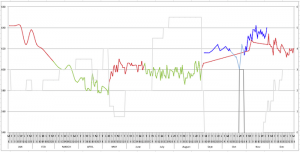
So, what do we do once our system is underway, and data is collected? The information can be more successfully applied to weight management. With regards to nutrition, monitoring trends can provide early indicators that small tweaks are needed; either to the quantities of existing products being used, or to the products themselves.
A plethora of options exist in the ever-advancing market, including vitamin and mineral supplements, licks, balancers, cubes, and mueslis - which all come with specific guidelines on the feeding rates or quantities needed per day to ensure nutrient needs are satisfied for a horse’s current weight. Remember that digestible energy indicates the calorie content of the feed, and there are both low calorie large volume feeds (for example many balanced fibre-based options), and high calorie low volume options (for example many concentrated ‘build-up’ products). Forage must not be discounted, in that it should make up most of the horse’s daily diet (hay, haylage, pasture), and can also vary in energy, vitamin, and mineral content. Testing services are available should horse owners want to assess their horse’s forage and/or pasture contribution to their daily diet.
Once a horse’s exercise, nutrition, and management programmes are established, photos, condition scores, and heart and girth measurements can help objectively establish whether condition is changing despite a stable weight. These monitoring methods are instrumental in the maintenance of ideal condition and are also valuable indicators of the marginal gains described earlier, which can help make the difference when we’re trying to outcompete at the highest levels of equine sport right the way across to grassroots and leisure goals.
If horse owners would like to learn more about the various body condition scoring methods, discuss their horse’s individual requirements and their nutritional programme in support of weight management, or learn how to use a weigh tape, please suggest they try contacting our Nutritional Helpline on 01832 737300 Option 3.
