

From woodland discovery to global brand: the Classic Canes story
As the renowned walking stick specialists change hands after four decades of family ownership, managing director Charlotte Gillan reflects on a remarkable journey of British craftsmanship and family enterprise.
In the late 1970s, when Ben and Diana Porter purchased a woodland property in Somerset with a ruined Tudor hunting lodge, they had no idea they were planting the seeds for what would become an internationally recognised brand. What began as a fortuitous discovery — that their woodland naturally produced ash and hazel perfect for walking sticks — blossomed into Classic Canes, a business that would define their family for over 40 years.
"Family businesses play a huge role in the life of their family," reflects Charlotte. "They are far more than just a means of earning money: they are a way of life, an identity even."
Humble beginnings
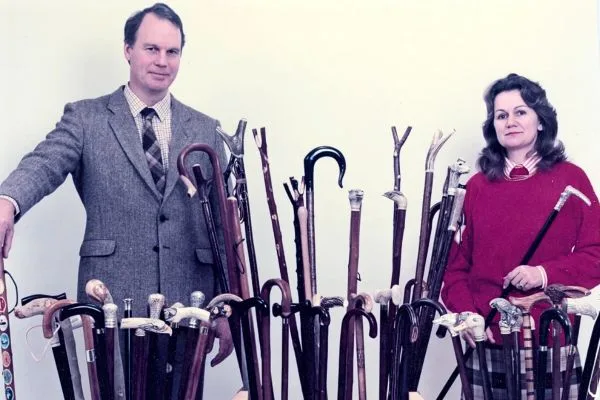
The business started almost by accident in 1982. While selling raw materials to the Coopers walking stick factory in Surrey, Diana Porter spotted an opportunity. With a background in sales and marketing, she purchased £450 worth of finished products and began selling them to local shopkeepers from the back of her estate car between school runs.
"The early range was quite limited: wooden crooks, Derbys and long, country sticks," recalls Charlotte. "In those days, sticks were mostly very plain and there were few designed especially for women. Ladies mostly had to make do with a man's stick cut down in length, which was neither elegant nor comfortable."
Before digital technology transformed business operations, establishing a supplier network meant trips to the County Library to search directories. Marketing materials were expensive, and orders were written by hand on triplicate pads and calculated manually.
Growth and innovation
Despite the challenges — and the fact that most UK startups don't survive their first three years — Classic Canes was profitable by year three. The business benefited from an unexpected gap in the market when several wholesalers failed during the early 1980s recession, creating demand for a new walking stick supplier.
"When my father saw how well my mother's little business was doing, he worked out how much more it could be earning with a second person's input," says Charlotte. Long-time customers may remember selecting their sticks from the back of his van as he processed orders on an early laptop with a portable printer.
The company's expansion accelerated in the late 1990s when Classic Canes made its debut at trade fairs. Their first major exhibition was the Spring Fair at Birmingham's NEC, where Diana secured a last-minute cancellation slot and prepared a stand in just two weeks, sewing the backdrop herself. The exposure attracted international buyers from Europe, America, and Japan.
The equestrian world became an important market for the company. "We exhibited at BETA many times over the years, expanding our network of country clothing and saddlery stockists," Charlotte explains. "BETA had by far the best fashion show of any fair: those wonderful dancing models were exceptional at using our walking sticks and
Family affairs
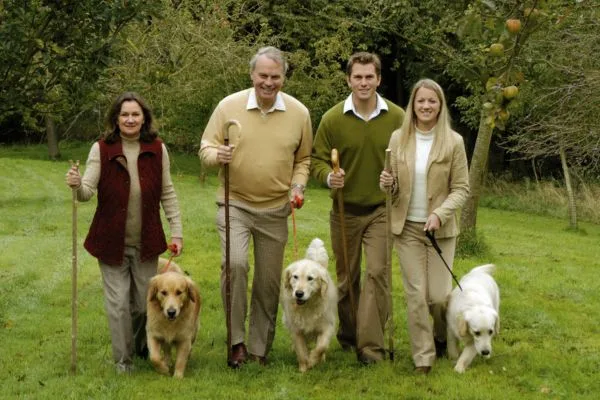
For Charlotte and her brother Johnny, Classic Canes wasn't just their parents' livelihood — it was woven into the fabric of their childhood. Walking sticks were stored under their beds, and they earned pocket money sticking code labels onto products. Johnny learned to count by packing rubber ferrules into bags of ten.
"We learned at a young age about cashflow and saw the consequences of its ebbs and flows in our daily lives: a great business education for any child," says Charlotte. The siblings even modelled for company catalogues alongside the family's golden retrievers — though it was the dogs who often stole the show and became customer favourites.
One particularly large order from Johnny Walker whisky company in the USA funded an extension to their warehouse. When Diana asked the American buyer why she had chosen Classic Canes, hoping to hear praise about their service or quality, the response was unexpected: "Oh honey, we looked at your website and we just loved your dogs." The canine models featured prominently in their marketing thereafter.
Brand building and design innovation
When Charlotte returned to the family business in 2003 after working in luxury goods marketing, she brought fresh perspectives. One of her early initiatives was implementing barcodes, but her most significant contribution was elevating Classic Canes from a walking stick supplier to a prestigious brand that retailers were proud to stock.
"I felt strongly that we needed to brand the products 'Classic Canes' so the public could identify and ask for our sticks," she explains. "It was a good decision... 'We tell our customers you are the Rolls-Royce of walking sticks' is a story we have heard many times and it never fails to warm our hearts."
Charlotte also took on the design aspect of the business, creating exclusive patterns for walking sticks when commercial artists couldn't deliver exactly what she envisioned. Her designs ranged from horses, dogs, and cats to modern art-inspired motifs, helping to distinguish Classic Canes from competitors and defeat copyists.
The company's catalogues became known for their ‘lifestyle’ photography, which portrayed walking sticks as fashionable accessories rather than merely mobility aids — an important step in breaking down stigma around assistive devices.
Navigating challenges
Like all businesses, Classic Canes faced its share of obstacles. During the COVID-19 pandemic, sales plummeted to just 8% of normal levels in March 2020, and employees were furloughed. Charlotte found herself single-handedly managing office administration, finances, and warehouse operations, with some assistance from her mother who, in her 70s, returned to packing the few orders they received.
The post-pandemic landscape brought further changes. Traditional trade fairs were no longer viable, and many independent high street shops that had been loyal customers closed their doors. The business adapted by shifting toward online retailers and garden centres, while embracing social media marketing — platforms that would have been unimaginable during the company's early days.
Passing the torch
Now, after 42 years of family ownership, Classic Canes is changing hands. When the Gillan family announced their decision to sell, many customers expressed not only congratulations, but curiosity about the process — some confiding their own desires to sell their businesses amid changing economic conditions and increasing employment responsibilities.
As Charlotte reflects on their journey, she acknowledges the interconnected network that supported their success: "Our customers have been a fascinating part of our lives as have all our suppliers, both of stock and services: trade magazines, freight agents, printers, packaging suppliers who went to great trouble to make long, thin walking stick cartons for us... the list of indispensable people, not least our dedicated employees, goes on and on."
The Classic Canes legacy stands as a testament to family entrepreneurship, British craftsmanship, and the ability to evolve with changing markets while maintaining quality and character. For equestrian retailers and country outfitters, the ongoing clearance sale offers excellent opportunities to acquire pieces from this storied brand.
The Classic Canes clearance sale features many bargains ideal for saddlers and country clothing stores. Contact info@classiccanes.co.uk or www.classiccanes.co.uk for further information.
