

Know your feed sack
Many customers will be guilty of buying a feed based on the name and even the colour of the bag but, without reference to the wealth of information which can be found on the packaging, will be disappointed with the results when fed to their horse.
Just a little time spent in the shop, and in the feed room, can mean the difference between money well spent on the right feed, providing the horse with a balanced diet, or disappointment and frustration with a horse who doesn’t look or feel how they’d hoped.
The information printed on a feed bag is there to help you and your customers make an informed choice about which product is most suitable for their horse. Some details must be there by law, the rest are there at the discretion of the manufacturer.
Here we take a look at just what you may be faced with.
The statutory statement
This is the part that manufacturers must make available on the packaging by law and its content is stipulated by the UK Food Standards Agency’s Animal Feed Regulations. It may be printed on the bag, on a sticker or on a stitched-on label, and includes the following:
The name of the feed
This should, but may not, indicate what type of horse the feed is intended for.
A description of the feed - ie. whether it is to be fed as a ‘complete’ feed (nothing else is required) or as a ‘complementary’ compound feedstuff (designed to be fed alongside forage but as the sole concentrate source). The manufacturer must also state which species the feed is intended for.
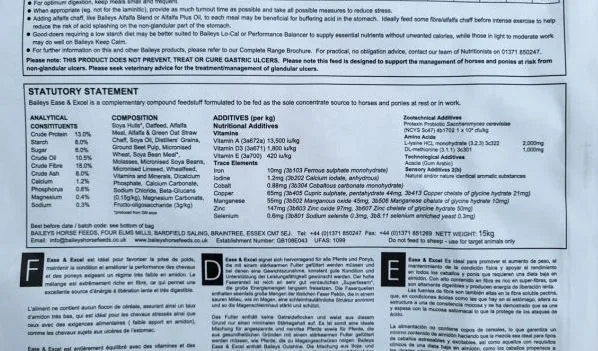
Analytical Constituents – previously known by the much more explanatory name of ‘Nutrient Analysis’! By law manufacturers only have to declare the levels of certain nutrients, namely Crude Protein, Crude Fibre, Crude Oil, Crude Ash, Sodium and Vitamins A, D and E. Levels of other vitamins and minerals are mentioned at the manufacturer’s discretion and, just because some may not be declared, it does not mean that they are not in the feed.
Any additive or ingredient whose benefits are referred to elsewhere on the packaging, website or marketing literature must be listed within the analytical constituents along with its inclusion rate, for example, yeast cultures, nutraceuticals, herbs etc. Any genetically modified ingredients, typically soya, should also be identified.
Crude Protein - does not distinguish between essential and non-essential amino acids ie. the quality of the protein content. Good quality protein helps build muscle and other tissues and does not affect temperament. Levels of Crude Protein are tailored to the requirements the feed is trying to meet, for example mixes and cubes for rest/light work may contain around 9% crude protein, those for moderate work, 11 -12% protein and those for hard work, 12 – 13%.
Due to their concentrated nature, balancers contain a much higher percentage crude protein so it’s important to remember feeding rates when looking at any nutrient levels. For example, for a 500kg horse in moderate work, 5kg per day of a 12% protein mix or cube will deliver 600g of protein, while 500g per day of a 26% protein balancer will deliver 130g of protein.
Crude Fibre – similar to the measure for Crude Protein, this does not indicate how digestible the fibre element of the feed is. As a guide, typical forages and chaffs may have a crude fibre content of 30-40%, while mixes and cubes termed “high fibre” may be 16-22% fibre. As with all individual nutrients in a feed, it should be considered as a percentage of the overall ration ie. forage + concentrate.
Crude Ash – an apparently strange term which, in fact, is a measurement of the minerals in the feed, such as calcium and magnesium, so is quite useful. It is arrived at when a sample of feed is incinerated so that all the fat, carbohydrate and protein is burned off, leaving just the minerals as ash.
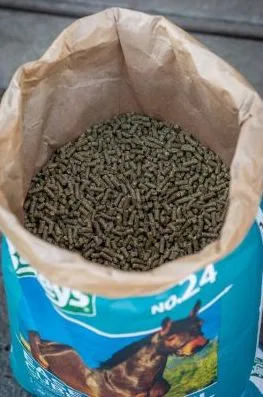
Composition
This is the ingredients in the feed, listed in order of inclusion rate, with the greatest first. If the composition is printed on the bag, rather than on a stitched-on label, it is a good indication that the manufacturer sticks to a consistent set of ingredients and doesn’t just use what is cheapest or most easily available at the time of manufacture.
These ingredients can also give you an indication of a feed’s quality, digestibility and the type of energy it is likely to supply. Soya is considered to be the best source of top quality protein, which includes essential amino acids that must be included in the diet, and is most commonly found in feeds for horses with elevated requirements, like competition or stud feeds. Other protein sources include alfalfa, field beans, peas, sunflower and some milling by-, or ‘co-‘, products, like wheatfeed or oatfeed.
Some fibre sources are rich in what are termed ‘superfibres’, which are more easily digested and yield more calories per kilo than traditional fibre sources, like straw, oatfeed or wheatfeed. These include alfalfa, beet pulp and soya hulls and these are often included in greater amounts in feeds designed to reduce or eliminate the reliance of cereal starch as a source of calories.
Additives
These may be listed under a number of headings and should only include those authorised for use in horse feed in the UK and on the register of feed additives:
Nutritional additives – vitamins/trace minerals - this covers the vitamins and minerals included in the feed and should also list the source(s) from which an individual mineral is derived eg. sodium selenite. Both vitamins and minerals must be given their appropriate registered number, which simply identifies the source used.
The term ‘fully balanced’ refers to a feed which is fortified with vitamins and minerals so that, when fed at recommended levels, typically alongside forage, it will provide a fully balanced diet supplying all the nutrients that the horse needs to meet requirements, with no further supplementation necessary. It is unwise to ‘play the numbers game’, when looking at feed labels, as it is the balance of these essential nutrients that is important and that will have been formulated to suit the ingredients and the specific requirements the feed is designed to meet.
Amino acids – the building blocks of protein, these are supplied by ingredients, like soya but, if the formulation requires higher levels of specific essential amino acids, these may be added separately.
Zootechnical additives – refers to any live micro-organisms – in the uk only yeast culture is authorised for use in horse feed and is added as a probiotic to promote digestive efficiency.
Sensory additives – flavours and aromas included to improve palatability, and colourings.
Technological additives – preservatives included to improve the shelf life of the feed.
Bag Weight
This is important when used alongside feeding rates for determining value for money.
Best before date and batch number or date of manufacture
Vitamins break down naturally over time so the ‘best before date’ is based on how long the ones in a particular feed will remain available and useful to the horse, as long as the feed has been kept in a cool, dry place out of direct sunlight. If there is a problem with the feed, the batch number and best before information is vital should you need to contact the manufacturer.
Name and address of manufacturer
Each manufacturer also has an “establishment number” which pinpoints the exact site of manufacture.
Other Information
Reputable manufacturers will include as much additional information as they can, to help horse owners, when looking at packaging in the shop, as well as to help them use the feed correctly.
Digestible Energy (DE)
Quoted as an ‘estimated’ value in Mega Joules per kilogramme (MJ/kg), this is extremely useful as a guide to the level of calories/energy the feed is likely to give. As a rough guide, feeds can be assessed as:
- Lower Energy/Calorie (ie. for rest/light Work) DE = 8–10 MJ/kg
- Medium Energy/Calorie (ie. for moderate work, some weight gain) DE = 10–12 MJ/kg
- High Energy/Calorie (ie. for hard work, considerable weight gain) DE = 12 + MJ/kg
In order to gain weight and ‘condition’, a horse must consume more calories than it uses for maintenance and work. A feed with a higher DE will deliver more calories per kg, so overall calorie intake can be increased, while keeping meal sizes manageable. It’s important to ensure that daily feeding recommendations are followed, however, as many may select the right feed but significantly under-feed it and be disappointed with the result.
Feeding Recommendations
This may include fairly generic advice on feeding as well as more specific recommendations on how much to feed per day. Contrary to popular myth, these are not over-inflated by the manufacturer to get owners to feed more than they need to! They are carefully calculated according to a horse’s bodyweight and workload, in order to deliver a fully balanced diet.
Owners may need to adjust levels up or down slightly, depending on the horse’s condition and if they are at all unsure, they should be encouraged to ring the manufacturer’s help line. If they feel that they really can’t feed what it says on the bag, then it is potentially the wrong feed for the horse.
Logos and other symbols
Those who compete in affiliated competition or racing, need to look out for the BETA UFAS NOPS logo, which means that the feed has been manufactured according to specific guidelines to minimise the risk of it containing Naturally Occurring Prohibited Substances.
BETA also recognise those feeds suitable for horses prone to gastric ulcers and which will carry an identifying logo. These meet stringent requirements with regards to cereal starch content which should be kept to a minimum in the diets of those suffering with or prone to gastric ulcers.
Individual manufacturers have also developed their own symbols and logos to highlight other benefits of the feed or types of horses for whom it is especially suitable eg those prone to laminitis. These may be unique to each brand, which is not always helpful and may take a little deciphering!
Descriptive terms
Terms like ‘non-heating’ and ‘free from whole oats’ are used generically by feed producers as they have standard meanings, which have been agreed industry-wide. For example, ‘non-heating’ describes a feed which “is less likely to produce excitable behaviour in some horses and ponies, when fed at recommended levels”.
There is also increasing provision of feeds which are ‘low starch’, with little or no cereal content, and which as a result are often also ‘high fibre’ and/or ‘high oil’ as these are used as alternative energy/calorie sources.