Laminitis – what your customers need to know, with Spillers
Laminitis is one of the most common reasons horse owners contact the SPILLERS™ Care-Line for advice, and not just in the spring. “Management of horses and ponies prone to laminitis should focus on reducing as many of the risk factors as possible, regardless of the season,” says Clare Barfoot RNutr Marketing and Research and Development Director at SPILLERS.
Through its work with the WALTHAM Equine Studies Group and the Laminitis Consortium, SPILLERS is helping lead the way to advance our knowledge and control of this devastating condition. Using the latest research Clare Barfoot has put together eight top tips for you to share with your customers, to help them keep their horses and ponies safe from laminitis, not just in the spring but all year round.
- Act sooner rather than later: The grass starts to grow actively when the soil temperature consistently reaches 50C and it can be very calorific. For every kilogram (dry weight) eaten, horses could be consuming up to 500g of water soluble carbohydrate (WSC) which may include up to 75g of sugar. Studies have shown that ponies turned out un-muzzled can consume up to 5% of their own bodyweight in grass. If the same applies to a 500kg horse, this would equate to a whopping 1.9kg (nearly 2 bags!) of sugar or 12.5kg of WSC per day from grass alone.
- Keep them slim: If your customer has an overweight horse or pony recommend they use what’s left of the colder weather to instigate a slimming programme. Advise them to reduce feed or change to a lower calorie alternative; balancers are ideal in this situation as they provide vitamins and minerals to balance the diet without unnecessary calories. Switching to a lower calorie forage is also advisable as well as soaking hay for at least three hours as it will help reduce the WSC level. However it is still advisable to have forage analysed as the WSC lost from soaking is not consistent; most feed companies can do this for your customers

- Use fewer rugs: Fewer rugs or no rugs at all will encourage a horse to burn off a few extra pounds keeping warm!
- Restrict access to pasture: Consider turning out at night when the grass will contain less WSC or install a strip grazing system to restrict the amount of grass available. Turning out in an arena or bare paddock can also be useful but a suitable alternative forage should be provided. Advise owners to be careful when just restricting time out on pasture as ponies in particular learn quickly that they need to maximise their time eating and can consume 40% of their daily intake in just 3 hours!
- Try a grazing muzzle: A grazing muzzle can reduce intake by up to 80% but it must be properly fitted, allow for drinking and you must let the horse or pony get used to it before leaving it on for long periods although they should never be left on for 24 hours a day.
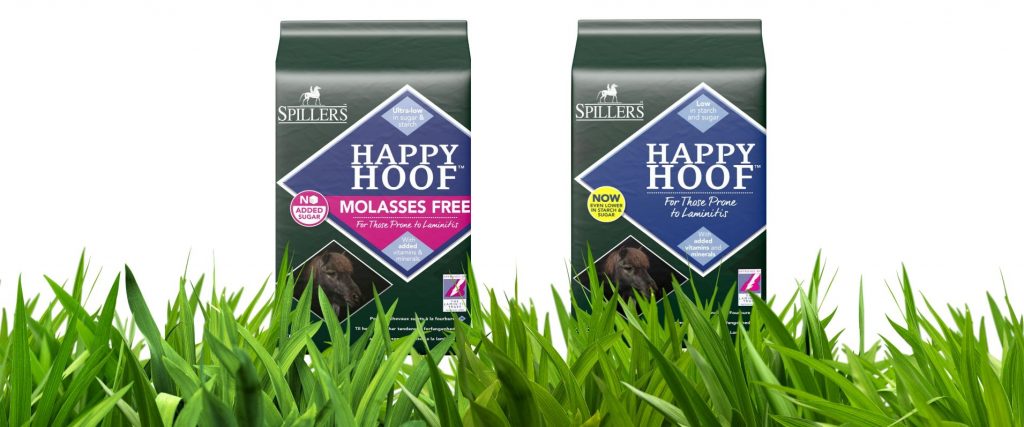
- Feed an alternative safe source of forage: For horses and ponies at very high risk consider removing them from pasture altogether and feeding them a suitable forage/ short chopped fibre, preferably one that has been approved by the Laminitis Trust such as SPILLERS™ HAPPY HOOF™ or SPILLERS™ HAPPY HOOF™ Molasses-Free, both of which are now even lower in starch and sugar and are approved by the Laminitis Trust.
- Beware of late frosts: On sunny, frosty mornings, WSC can accumulate to high levels and this may trigger the cascade of events that can lead to laminitis.
- Up the exercise: Regular exercise will help keep a horse’s waistline in check and support a healthy metabolism.
If you or your customers would like any specific advice on feeding a horse or pony prone to laminitis please call the SPILLERS Care-Line on 01908 226626.